
Sammamish, WA · Garage Door Service
Maintenance for Cottage Lake's 1980s Garage Doors
Garage door maintenance for Cottage Lake homes built around 1984, serviced from Sammamish, 11 miles away. Tuned to 1980s hardware, not a generic checklist.
- Repairs & new doors
- Springs & openers
- Serving 4 nearby communities
Time on the Job
Cottage Lake runs a median household income around $197,331, which matters more than it sounds like it should. At that income level, most owners aren't looking to replace a door that still opens and closes right - they want it kept that way. Repair and routine service make financial sense here long before replacement does, and that's the job we actually get called for.
We work out of Sammamish, about 11 miles south of Cottage Lake. That's not a same-day emergency distance - we don't claim a branch here, and we don't promise a response time we can't back up. What we do is run scheduled maintenance visits that plan around that drive: we batch the area when we're out this way rather than making a special trip for one door. If you're booking a tune-up, expect us to ask about timing that works with a route, not a dispatch board.
The houses themselves mostly date to around 1984, which puts Cottage Lake squarely in the same build era as the wider service area. That one number shapes almost everything else on this page - the hardware, the springs, and what tends to go wrong first.
Parts We Carry
A door built around 1984 almost always means a torsion spring system on a standard extension-style track, not the newer high-cycle springs you'd find on anything put up after 2000. We carry torsion springs wound for that mid-80s hardware spec, along with steel rollers for owners who haven't already swapped to nylon, and the galvanized cable gauge that matches what's already on the drum.
We don't stock every obsolete bracket from every manufacturer that's gone out of business since - if your door has a part so old or so specific that nobody makes it new, we'll tell you that straight, and we'll talk about whether a repair is even worth chasing at that point. That's the honest limit of what 'we carry' means. Most doors from this era use common enough hardware that we're not waiting on a special order, but not every one does.
What we don't carry on the truck is anything sized for a modern insulated steel door with a jackshaft opener - that's a different job with different parts, and we'd order for it rather than pretend the stock van covers it.
Doing It Yourself
There's real maintenance a homeowner can do between our visits. Wipe down the tracks and check for a buildup of grit or old grease that's gone gummy - a cold-climate issue more than people expect, since cold makes old lubricant stiffen and drag. Look at the bottom rollers for flat spots or visible rust. Check that the auto-reverse safety feature still stops the door against resistance.
What you shouldn't touch is the torsion spring itself. On a door built in the 1984 era, that spring is under enough tension to cause serious injury if it's handled wrong, and the winding cones on older hardware aren't always the same as what's sold today. If a spring looks stretched, rusted through, or the door feels heavier to lift by hand than it used to, that's a call, not a weekend project.
We're honest that a lot of garage door trouble is simple enough to fix yourself once you know what you're looking at - a loose track bracket, a dirty photo-eye sensor, a worn weatherstrip. We'd rather tell you that than have you wait for a truck for something that's a five-minute fix.
The Symptom
Cottage Lake sits in a cold, moderate climate band - not the harsh freeze-thaw cycling of somewhere further inland, but cold enough and damp enough that moisture is the recurring problem. On doors built around 1984, that shows up as surface rust forming on torsion springs and exposed cable where galvanizing has worn thin over four decades, and as hardened, cracked weatherstripping that no longer seals against the slab.
The symptom owners usually notice first isn't rust, though - it's the door getting noticeably heavier to lift, or the opener straining on the up-cycle. That's the spring losing tension as corrosion and age work on the coil, and it's a sign that's easy to miss until the spring finally gives out, usually in cold weather when metal is least forgiving.
A second common complaint: tracks that bind or stick on cold mornings. Old grease thickens, rollers drag, and a door that's run smoothly for years suddenly groans partway up. It's rarely the opener's fault - it's the original hardware finally asking for attention.
How We Fix It
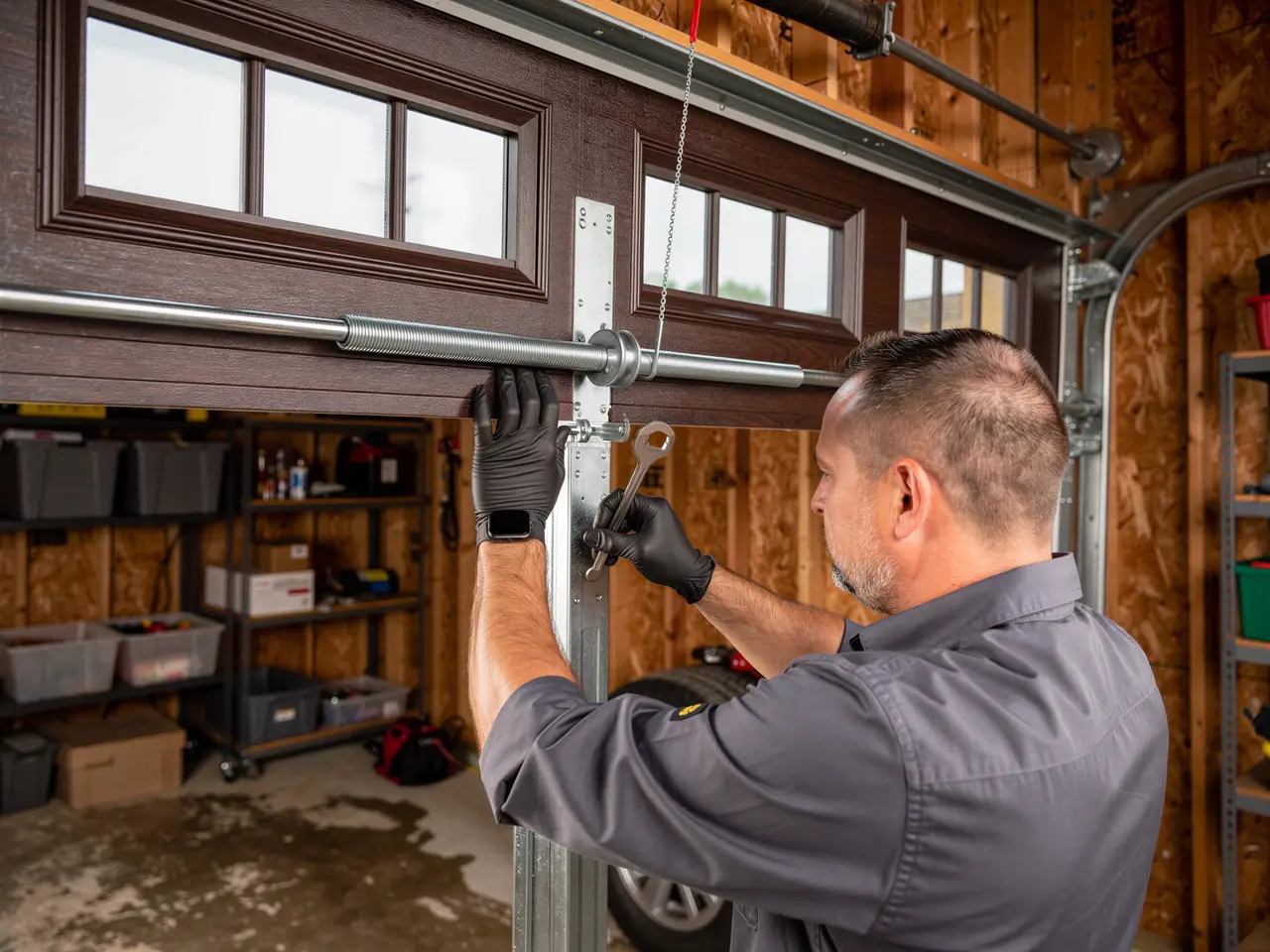
A standard maintenance visit starts with a full-cycle check: we run the door several times watching the springs, cables, and rollers under load rather than just eyeballing them sitting still. On 1984-era hardware, we pay particular attention to spring tension - we check it against the door's actual weight rather than assuming the original setting is still correct, since springs lose tension gradually over decades.
From there it's lubrication of the track and hinges with a lubricant rated for cold conditions, inspection and tightening of all mounting hardware, and a check of the auto-reverse safety sensors. If we find a roller or cable past its useful life, we'll replace it on the spot with hardware sized to match - we don't swap in a mismatched part just because it's on the truck.
If the spring itself is corroded or close to failing, we'll flag it clearly and give you the choice: replace now on a scheduled visit, or wait and risk it failing on its own timeline, which is rarely a convenient one. We'd rather you make that call with full information than find out the hard way.
What You Pay
We don't post a flat maintenance price here because the job depends on what we find - a door that's been neglected for years takes longer than one that's had regular attention. What we can tell you is how the repair-or-replace decision tends to shake out for a household at Cottage Lake's income level: with a median around $197,331, most owners we talk to would rather spend on keeping a sound door running than replace it outright, and the math usually backs that up. A torsion spring, a set of rollers, or a cable replacement on a 1980s door is a fraction of what a full replacement costs.
That changes once a door's frame or panels are failing, not just the hardware - at that point tune-up money is being thrown at a problem maintenance can't fix. We'll say so plainly rather than bill you for a visit that won't solve anything. For details on the broader range of repair and installation work we do out of Sammamish, see the maintenance page for the main service area.
Frequently asked questions
Do you have a shop or truck based in Cottage Lake?
No. We're based in Sammamish, about 11 miles away, and we travel out to Cottage Lake for scheduled work. We don't advertise a local response time because we don't have a branch here - if you need something same-day, ask us directly what's realistic given the drive.
Why does the age of my house matter for garage door maintenance?
Cottage Lake homes are mostly from around 1984, which means torsion spring systems, steel rollers, and cable gauges specific to that era. Knowing the build era tells us what hardware to expect before we even open the door, which is part of why maintenance visits run efficiently.
Is it worth fixing an old door or should I just replace it?
At Cottage Lake's income level, repair almost always wins unless the frame or panels themselves are failing. A spring or roller replacement on a sound 1980s door costs a fraction of full replacement. We'll tell you plainly if a repair isn't worth chasing.
Why does my door get heavy or noisy in cold weather?
Cold, damp conditions thicken old lubricant and corrode galvanized hardware over time, which is common on doors from the 1980s. That shows up as a heavier lift, a straining opener, or a door that sticks partway through its cycle on cold mornings.
More garage door services in Cottage Lake
Book garage door service in Sammamish
Call now or request a quote - tell us what the door is doing and where you are.